This
is nothing more than a continually evolving page to bring together
various Rivendell items which have been dispersed to the web:
Riv-Triv
about newer models, product previews and some catalog
and Reader scans, when requested by the folks on the RBW Owners
Bunch list. I've wrangled things around so that the newest stuff
is first - and clicking
on Newest Rivendell "Spy" Photos and
Intel should jump you down past this intro to the most recent
entry.
In
addition to the blog-like entries, there are a few other items of
interest which have sections of their own -
Most
of these images were originally shared via the Rivendell
Bicycle Works mailing list, which had been maintained at bikelist.org.
As of 3/25/07, this list is no longer operational, following a decision
by Rivendell not to participate in the list. In the wake of this
decision, I've created an "RBW Owners' Bunch" list through
Google Groups in order to continue the idea of the list - a focus
on Rivendell products in a polite and respectful environment.
The
link to this group is -
http://groups.google.com/group/rbw-owners-bunch. The minmum
recommended guidelines are here.
I periodically post a "State of the List" update, which
can be found here. Skimming
through the "SOTL" updates will give you a good idea of
the tone on the list,, as well as list-specific information.
If
you are a Rivendell bicycle owner, enjoy their products, approach,
or even just have a curiosity about things Rivendell, please feel
free to join in. Google groups allows posting for members through
either regular email or a web interface. The first step is to join
the group, which you can do by using the links below:
Return
O' the Derby - Sweaters and Vest Preview - 2/11
Early
versions of the Derby Tweed sweaters and vests which should
be available through Rivendell by mid-year. Clicking on the
image below will take you to the Rivendell PDF Archive page,
which will let you download the full sized pdf published by
Rivendell.
Stem
Tools and Definitions - Some Links
An
attempt to organize and aggregate the pdf's which have been
issuing forth from Rivendell bicycle works this year.
Includes
the "Design Your Frame" exercise led by Grant Petersen,
as well as the various preproduction samples and insider news
on frame models which have been published. There are still
a few missing here and there, and I'll try to incorporate
some of the earlier ones which have already been listed here.
In the meatime - enjoy!
Over
on the RBW Group, we had a little chat about stems, extensions,
reaches and how to get the bars where you think you want them.
As we found out, it's important to distinguish between REACH
and EXTENSION when discussing stems (shown on the Habanero
chart, among other places.) Since I know I'll want to find
these again, here were the resources which deal with this
setup:
The
Great Scot, A.Homer Hilsen (Written
two years ago for fun, found deep in a file when I was looking
for something else, briefly updated and exposed.) It takes
a while to read, but if you're bored...
On the high bluffs of Ben Nevis
On that highest mount in Scotland
Which o'erlooks grand fields of bluebells
Blazing in the verdant meadows
See the shining ribbon eastward
Aberdeen, the silver river!
Spy the sea beyond its south cliffs
Gaze at thick and constant clouds there
That 'cept for a week in August
When the winds blow hard and northward
Are opaque, as boiled egg whites.
Yesterday,
I had an opportunity to visit the Rivendell Bicycle Works
Headquarters & Lair. Had a great time test-riding bikes
and hanging out. One of the brand-spankin' new things I
got to handle and enjoy was the second color option on the
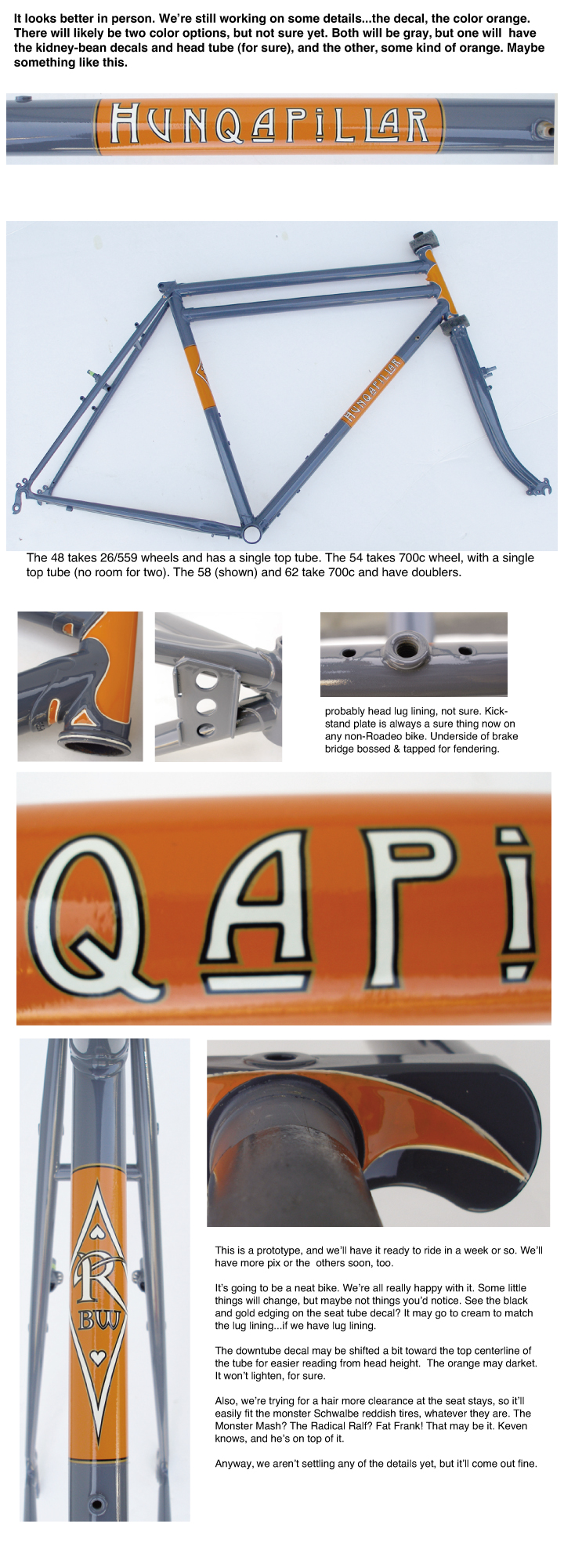
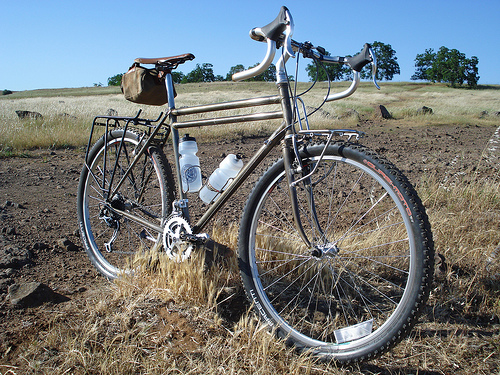
recently announced Hunqapillar
model from Rivendell. This was the same grey as before,
but had orange decals and contrasting paint, along with
lug-edge lining in cream. I really liked it and snapped
some photos which are over in my
flickr stream.
Grant
sent me a follow up emaill with a pdf that had a few more
images, as well as some musings. The pdf can be downloaded
here
or via
the RBW Group "Files" page. Because it's about
7 mb, I went ahead and converted it into a jpg as well.
It's only screen resolution, but should be plenty big enough
to enjoy on your monitor - click here or the image below.
What's
Going on on the Rivendell Owner's Bunch? - 12/09
"State
of the List Report" #9 - Update on the Rivendell Owner's
Bunch Group on google groups - over 1100 members and growing...
Hot
Off The Digital Press - 2009 (2010?) Rivendell Bicycle Frame
Catalog - 12/09
Not
sure if this will show up in a printed form, but here are
two pdf versions of the Rivendell 2009 Bicycle (Oriented)
Catalog which has appeared. There are two versions, one which
has each "page" on a separate pdf page, and the
other, which presents the "spread" (two facing pages).
As
with all the Rivendell ephemera, the writing is top-notch,
the images timeless and the points well-taken. Enjoy!
"Holiday
Pleadings" Email from RBW - updated with specific links
A
Rivendell Email was sent out on 11/27/09. If you didn't get
it, you can read it here.
In addition to a number of gift suggestions, it also has updates
on some changes in the Sam Hillborne, new size offerings in
the Betty Foy / Yves Gomez, a Quickbeam replacement called
the "Simpleone" and some news about the Atlantis.
"So
This Box Arrives With a Bike In It...NOW what do I do?"
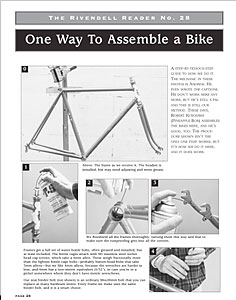
Reprinted
pdf version of
Rivendell Reader #28 - "One Way To Assemble A Bike".
Provides an excellent guide to anyone faced with the whole
gidditouttadabox issue. Also a good reference for anyone who
wonders why a bike shop charges for this service. This article
is in pdf format (~3 mb) rather than scanned as an image,
so it will download to your computer and require the Adobe
Reader (doesn't everyone have that
now...?) to, um, read it.
Big
tip o' the mouse to RivList member SethV, who provided the
file, and of course to GP at Rivendell, who wrote the thing
to begin with.
A
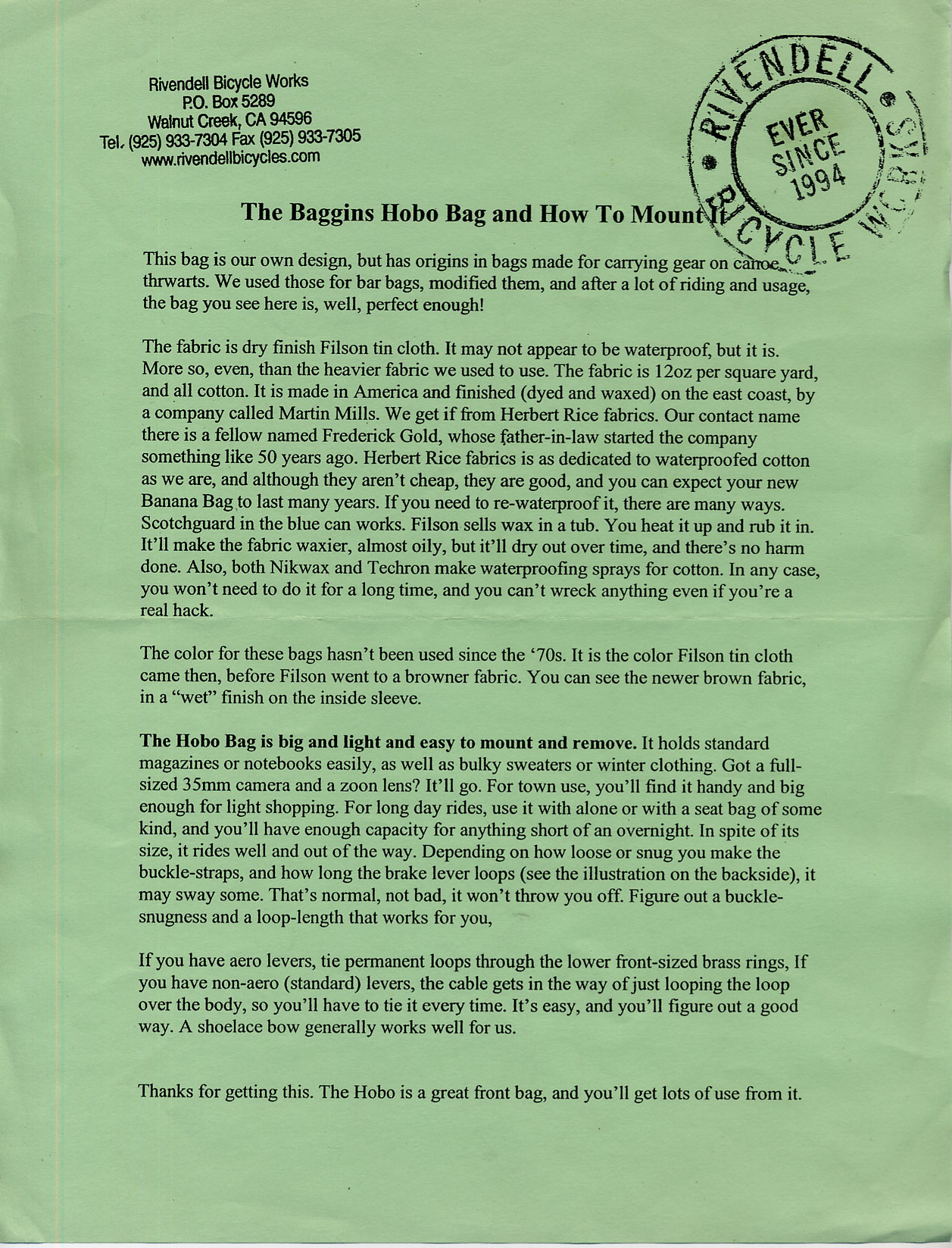
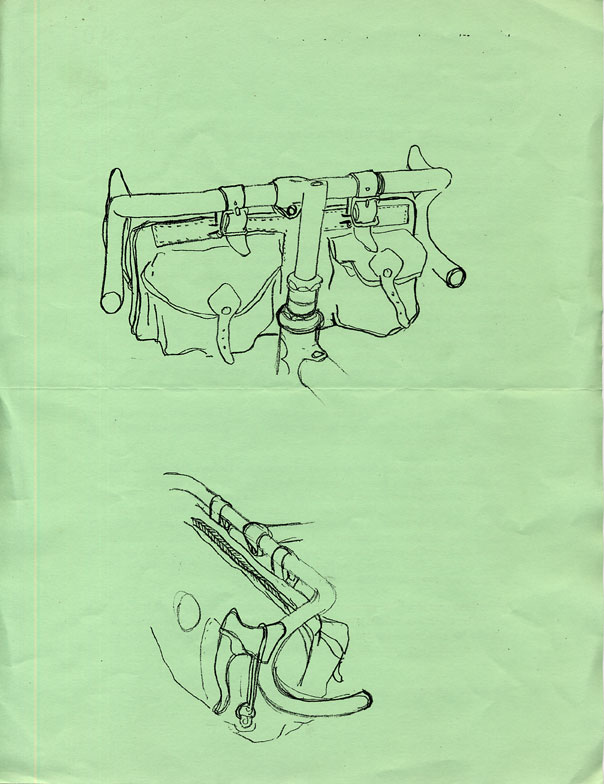
Manual For Your Baggins - Baggins Hobo Bag Accompanying Material
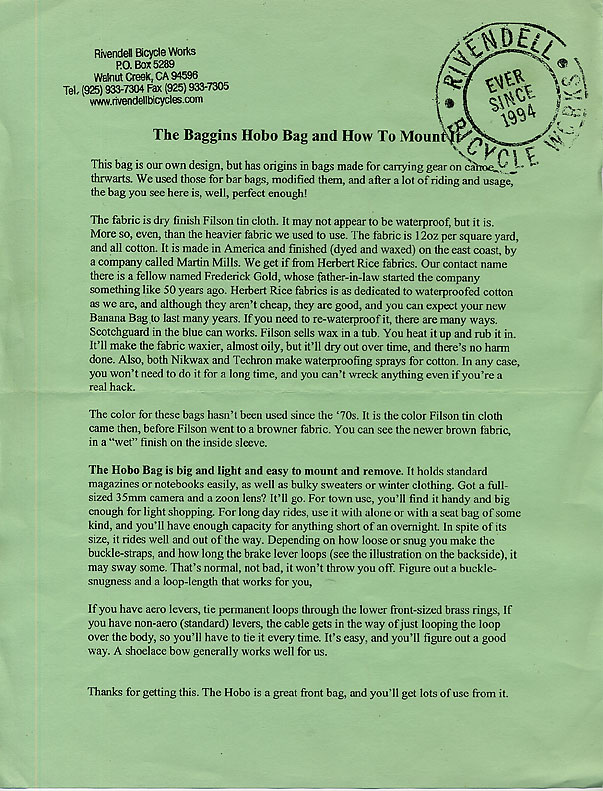
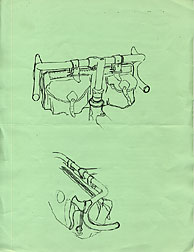
Confirming
once again that I never seem to throw anything away, this
piece of paper turned up when I was going through a file looking
for something else. It came with my Baggins Hobo Bag, and
described the materials, mounting options and other design
considerations with the bag.
I
don't use my Hobo bag too frequently now, which is really
a shame, as it's a robust and simple design which gives many
options. I'm also lucky enough to have one of the early ones
which has the rounded tree branch as the stabilizing bar,
rather than the dowels of later models.
Rivendell
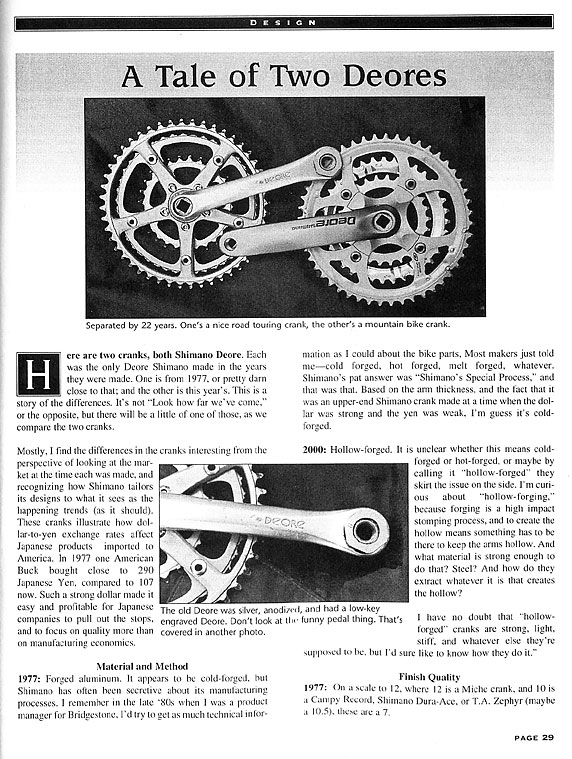
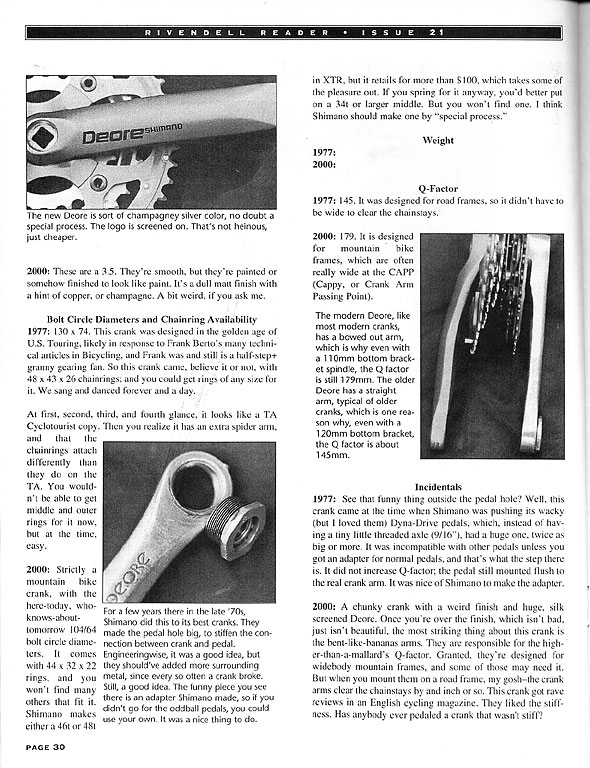
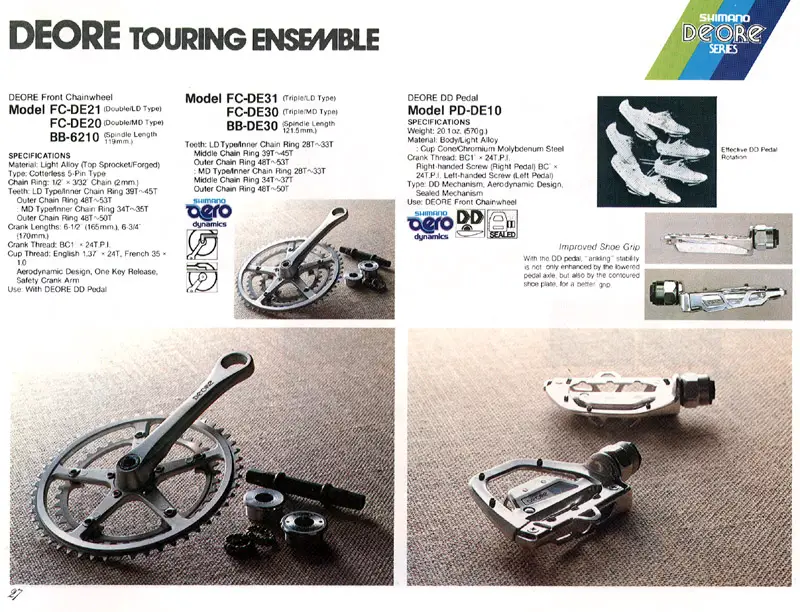
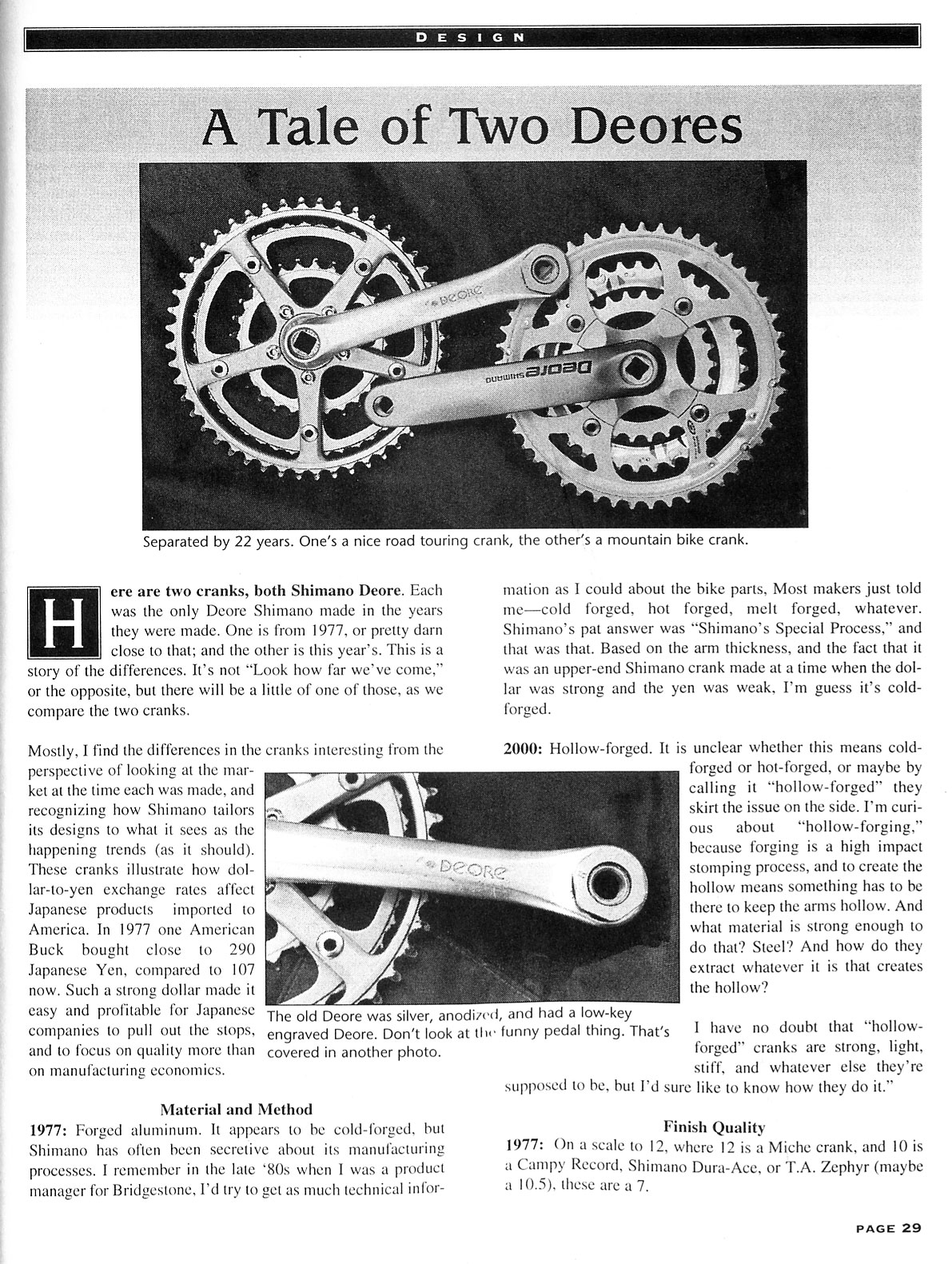
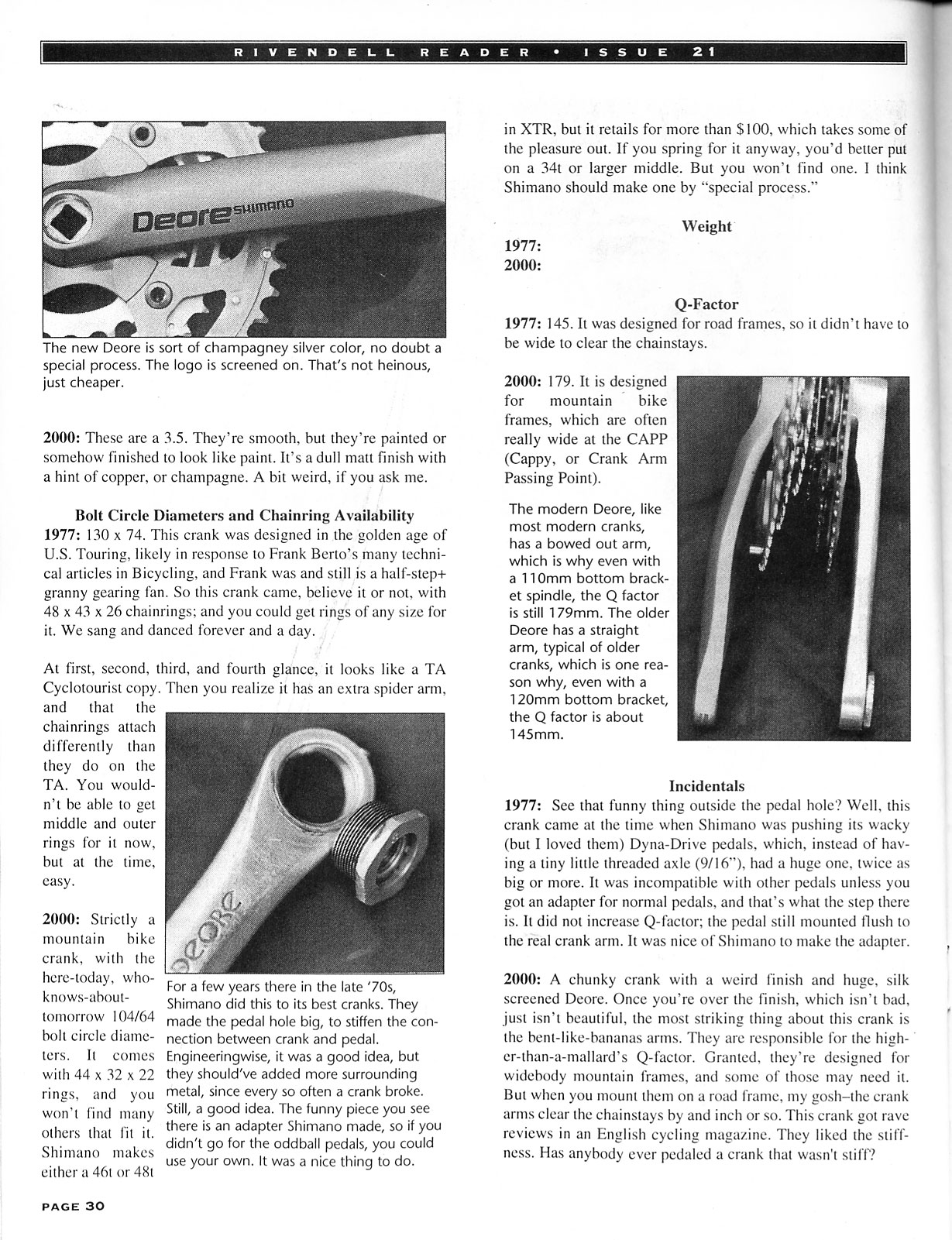
Reader Scan - RR#21 "A Tale of Two Deores"
Since
cranks are kind of on my brain today,
I rooted around and dug up this article for a
list member. It comes from Rivendell Reader #21 - Fall
of 2000 - and compares the Deore
cranks of old with the "current" Deore cranks
from that period.
The
"new" versions were using trickled down XT/XTR "hollow"
technology for the arms, but still used the proven and simple
square taper bottom bracket. The ISIS spline was just picking
up some momentum, and this is well before the outboard bearing
designs would replace those as the de facto choice.
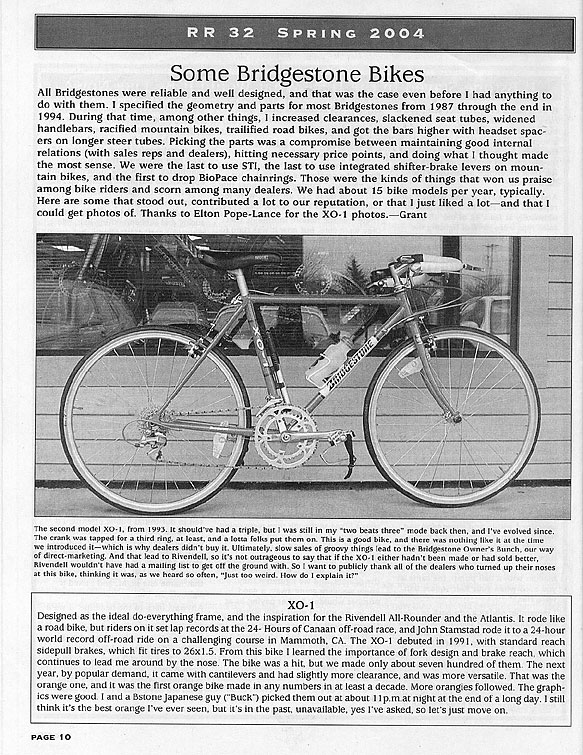
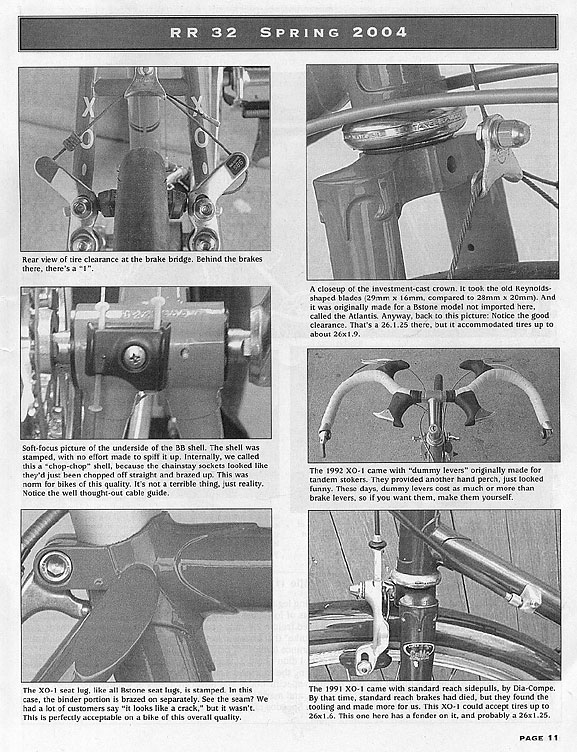
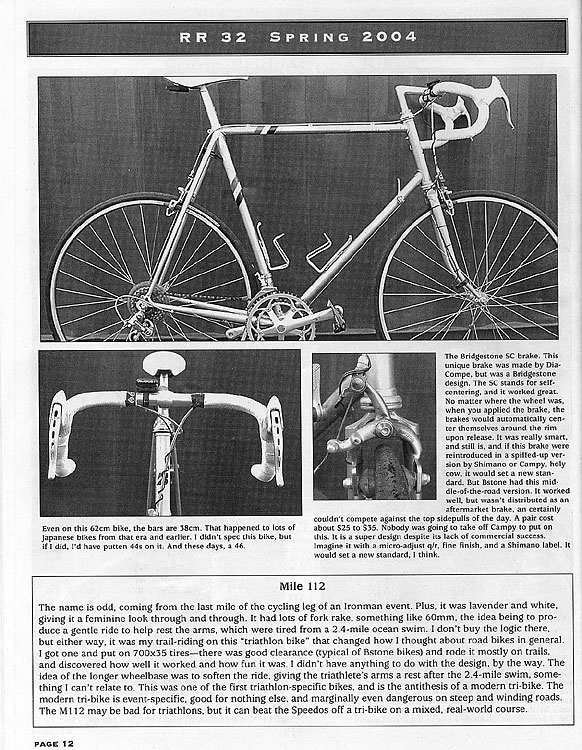
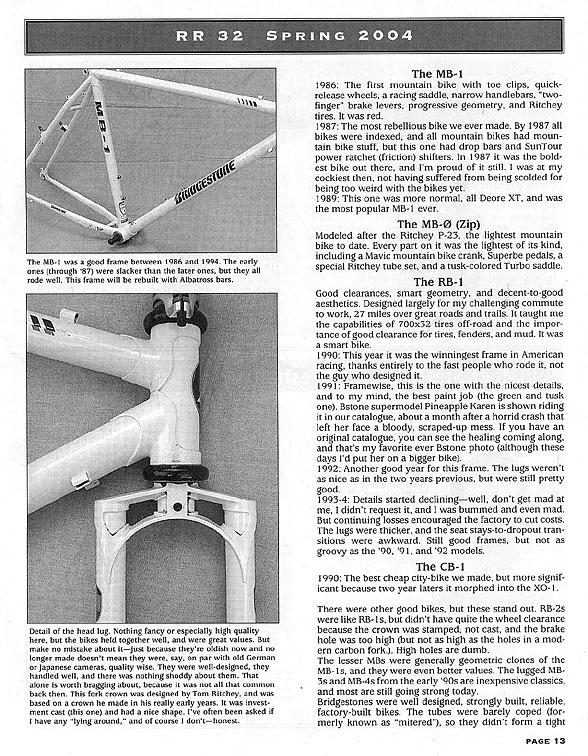
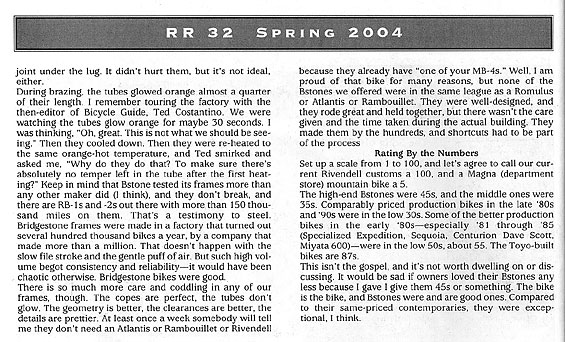
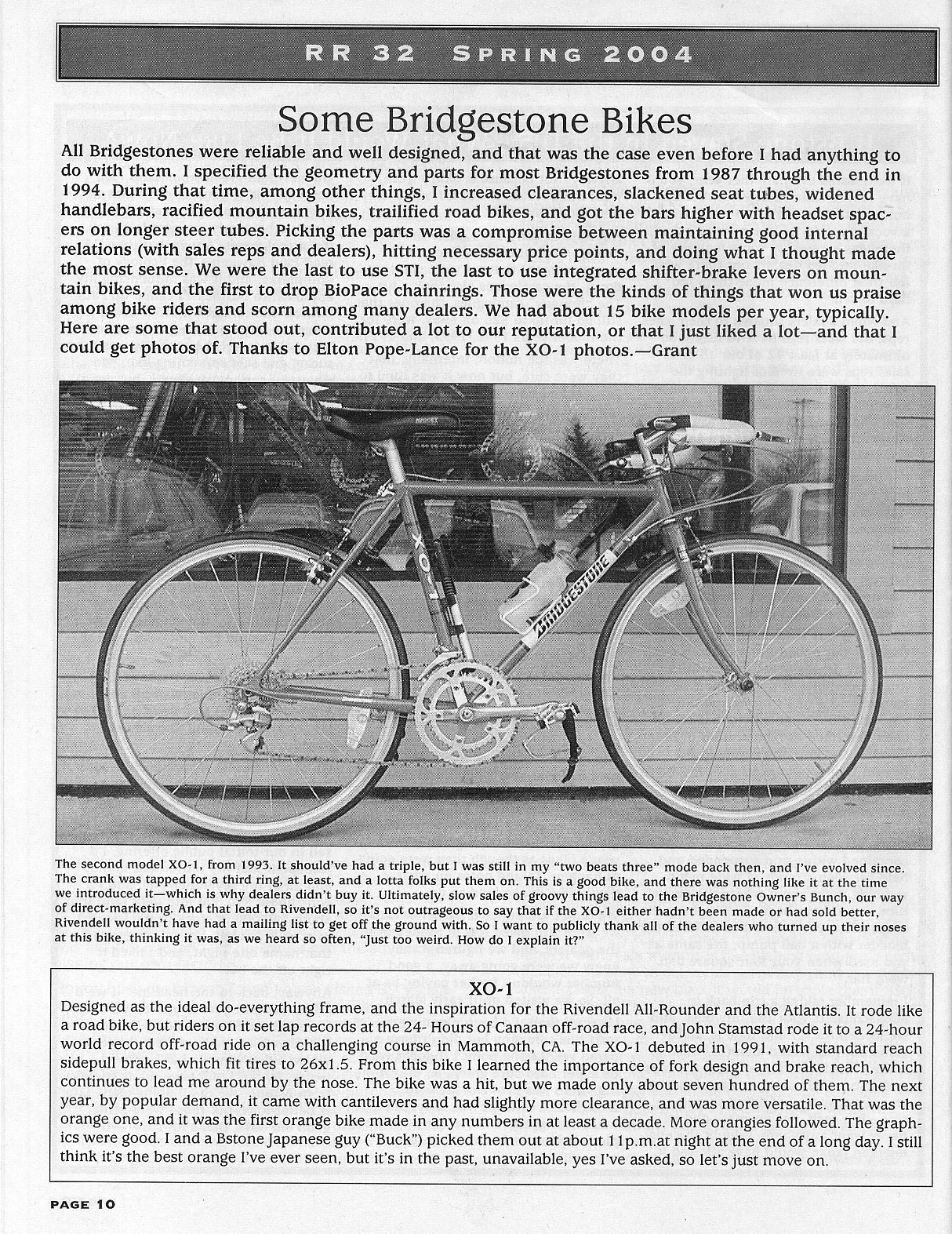
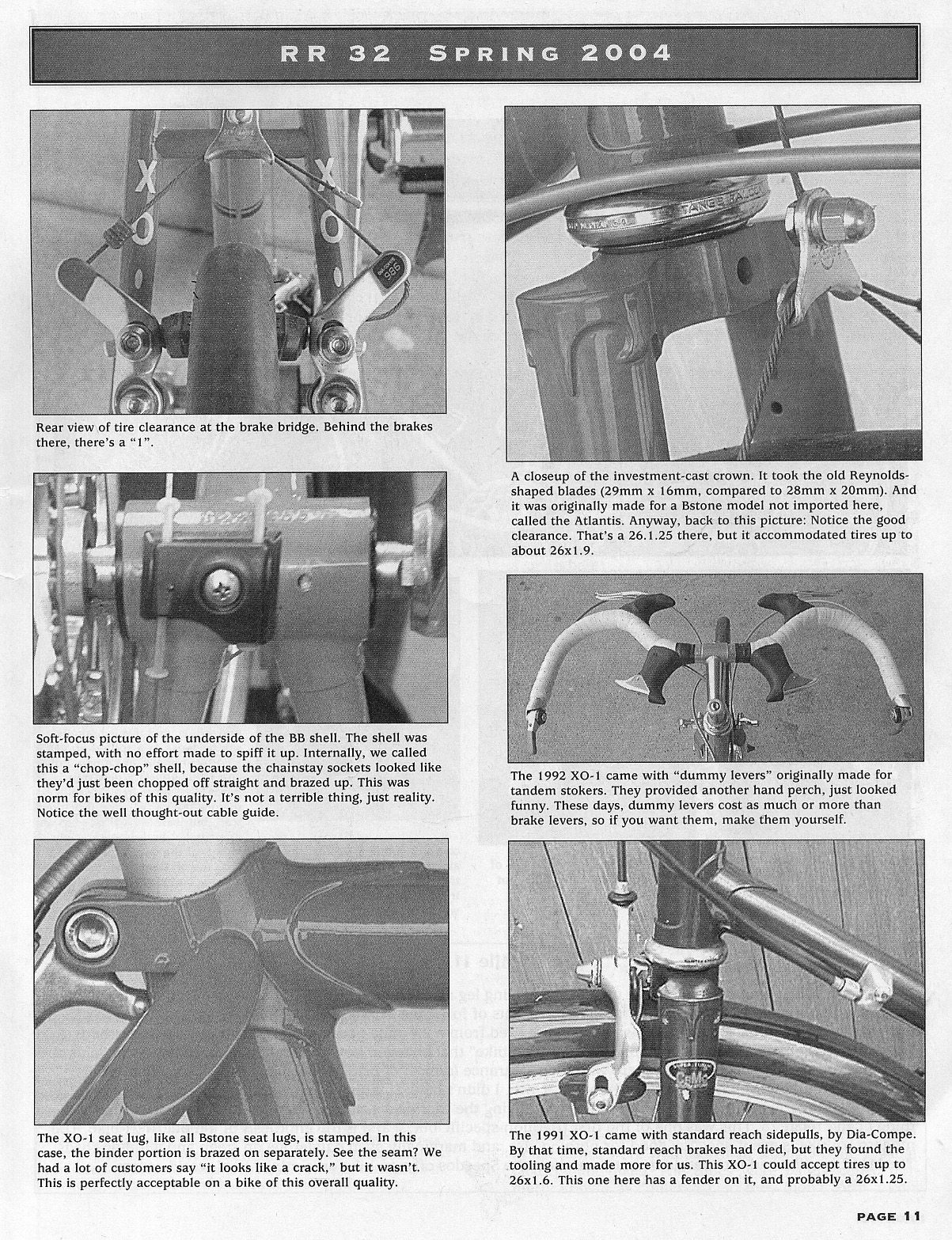
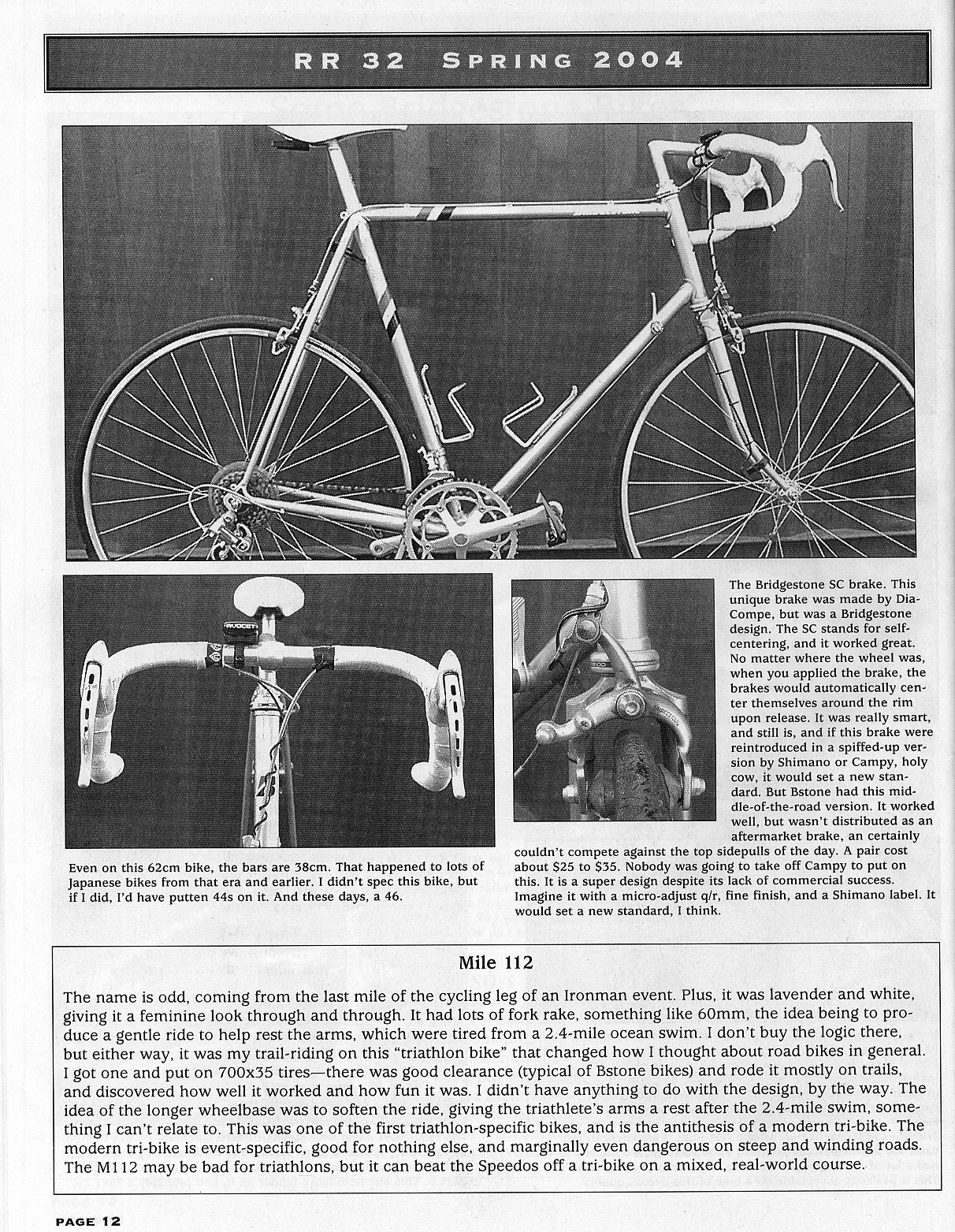
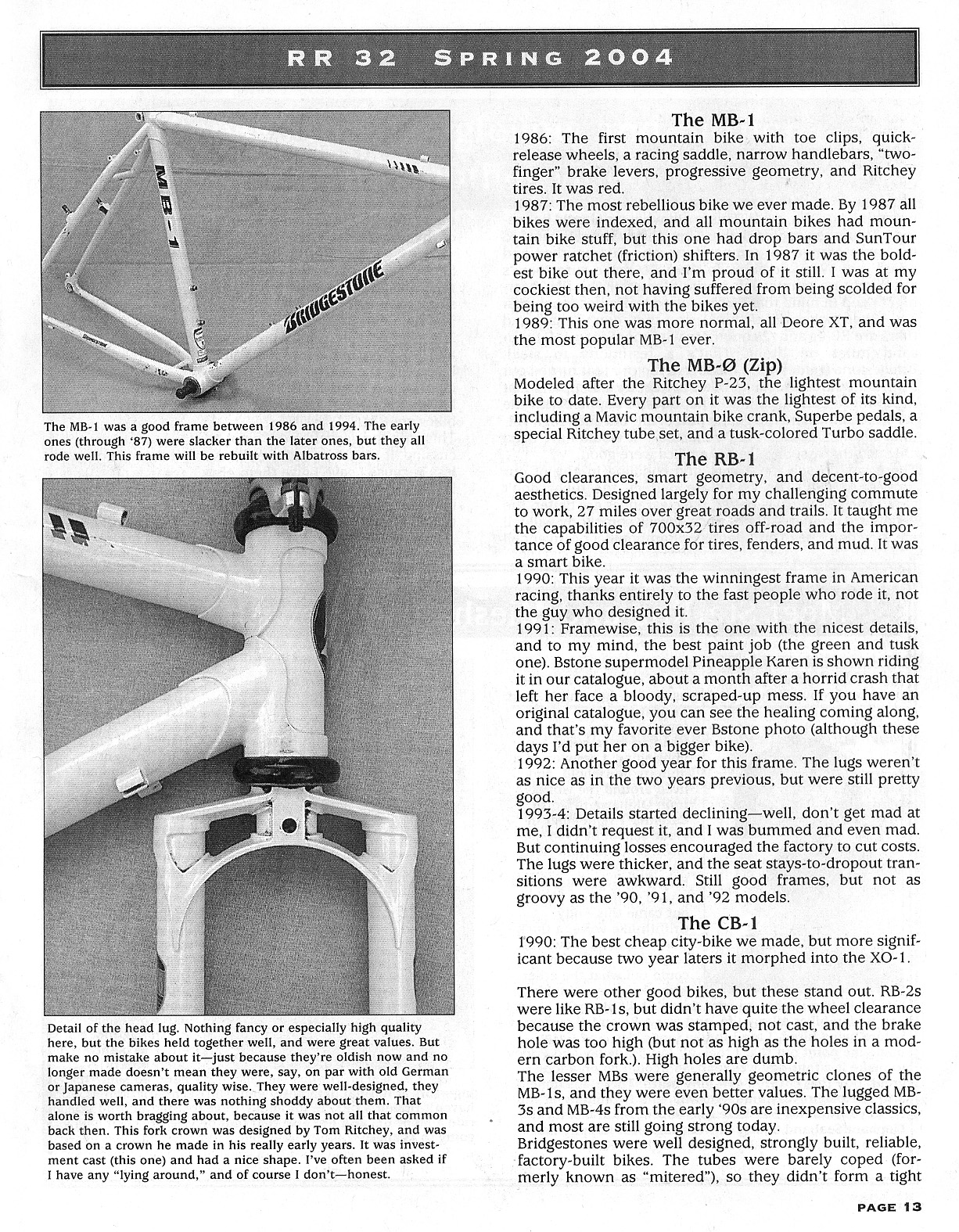
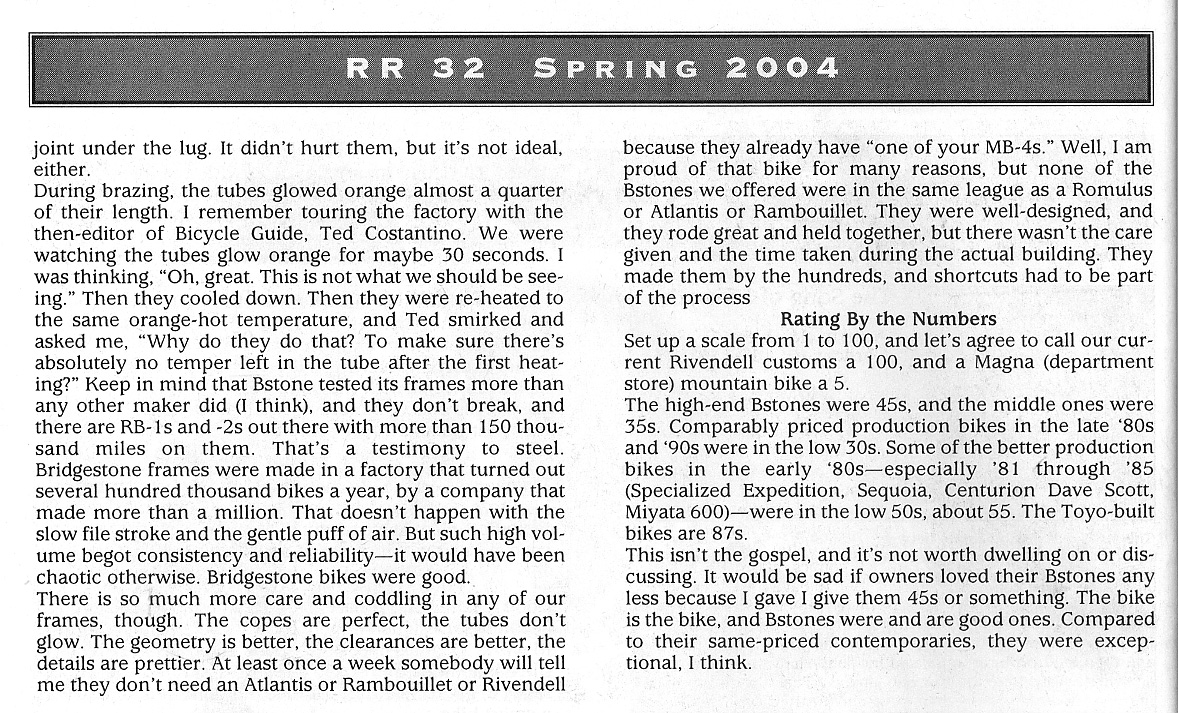
Scans
from Rivendell Reader #32, from Spring of 2004. This article
was titled "Some Bridgestone Bikes", written by
Grant about some of the models that stood out, contributed
to the reputation of Bridgestone during his tenure or he just
liked a lot. Interesting reading.
Clicking
on the image will provide a larger image. A higher resolution
version is also available.
"This
group is for discussion between owners (and prospective owners)
of the Rivendell Bleriot. We see the Bleriot Country Bike
as a "do it all" utility bike of the highest order that will
truly tap into what 650b is all about! It's lugged steel,
650b, an affordable price point, and a design that is nearly
perfect!
Since
production of the Bleriot frame has been discontinued, it
is entirely appropriate to extend the range of discussion
on this forum to include other inexpensive production 650B
bikes of Rivendell design (such as Betty Foy and Sam Hillborne)
as well as comparable bikes from other manufacturers."
Carter
on His Rivendell - 01/09
One
of those little "in the know" things for Riv-fanatics.
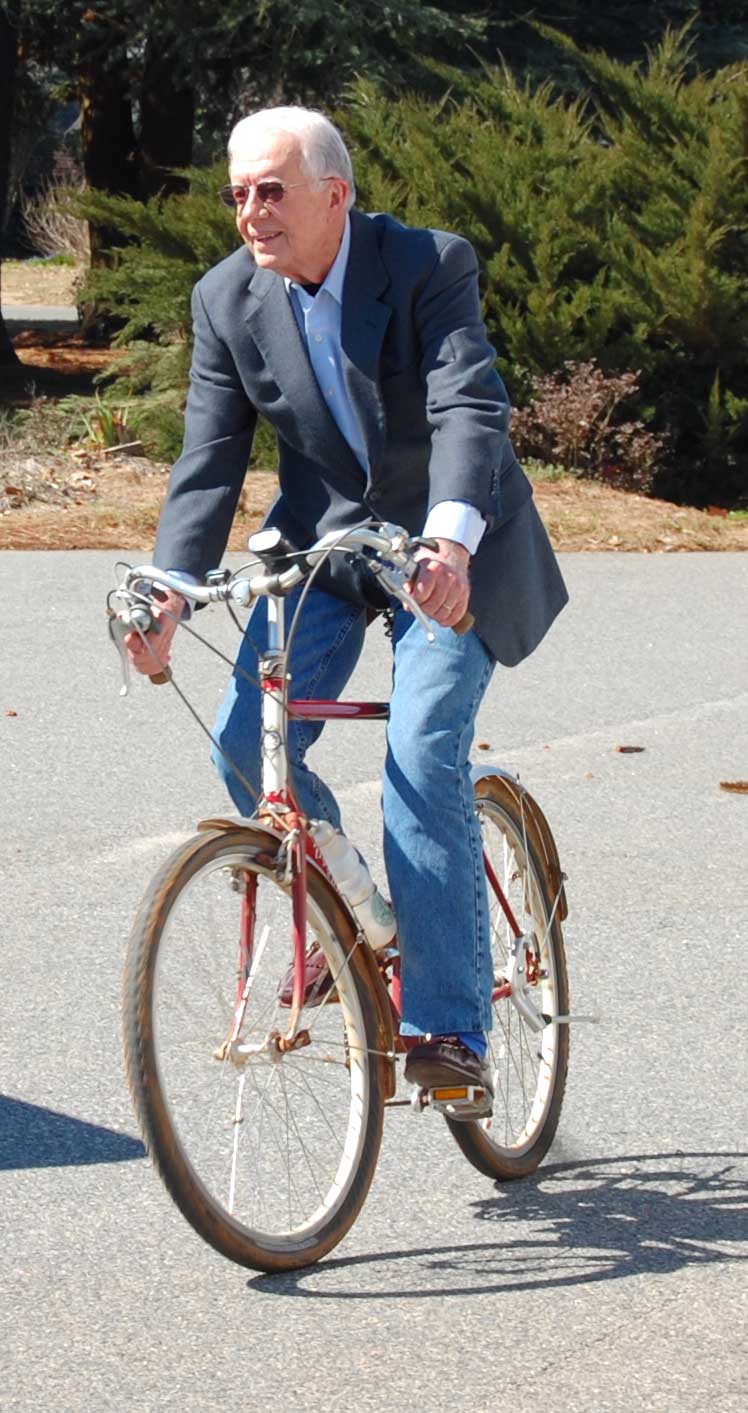
President Jimmy Carter is a proud Rivendell owner. And he
looks dang good in this photo which turned up on copenhagencyclechic.com
While
he might need to reset that fender line on the rear wheel,
it's clear that bike gets to see a bit o' trail, now and again.
Correlation
Between Mac's and Rivendells - 01/13/09
Silly
little survey slapped together in response to an iBob (and
now ported over to the RBW Owners' Bunch) thread - "How
many Rivendell owners are also Mac computer owners?"
If
the above form doesn't work, you can play along here:
It's
mostly pdf's, but worth a glance and a read - especially the
article from what must be '96 or so that pops up on the first
page. I always enjoy a good ride in a time machine.
And,
if you don't already do so, it's worth checking out the Reno
Rambler blog - renorambler.blogspot.com
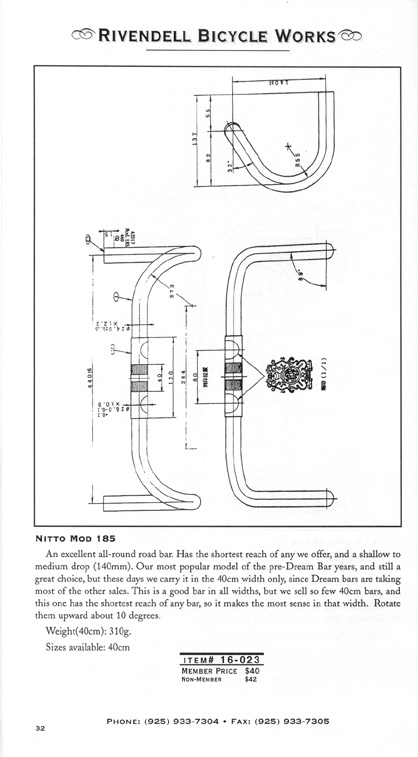
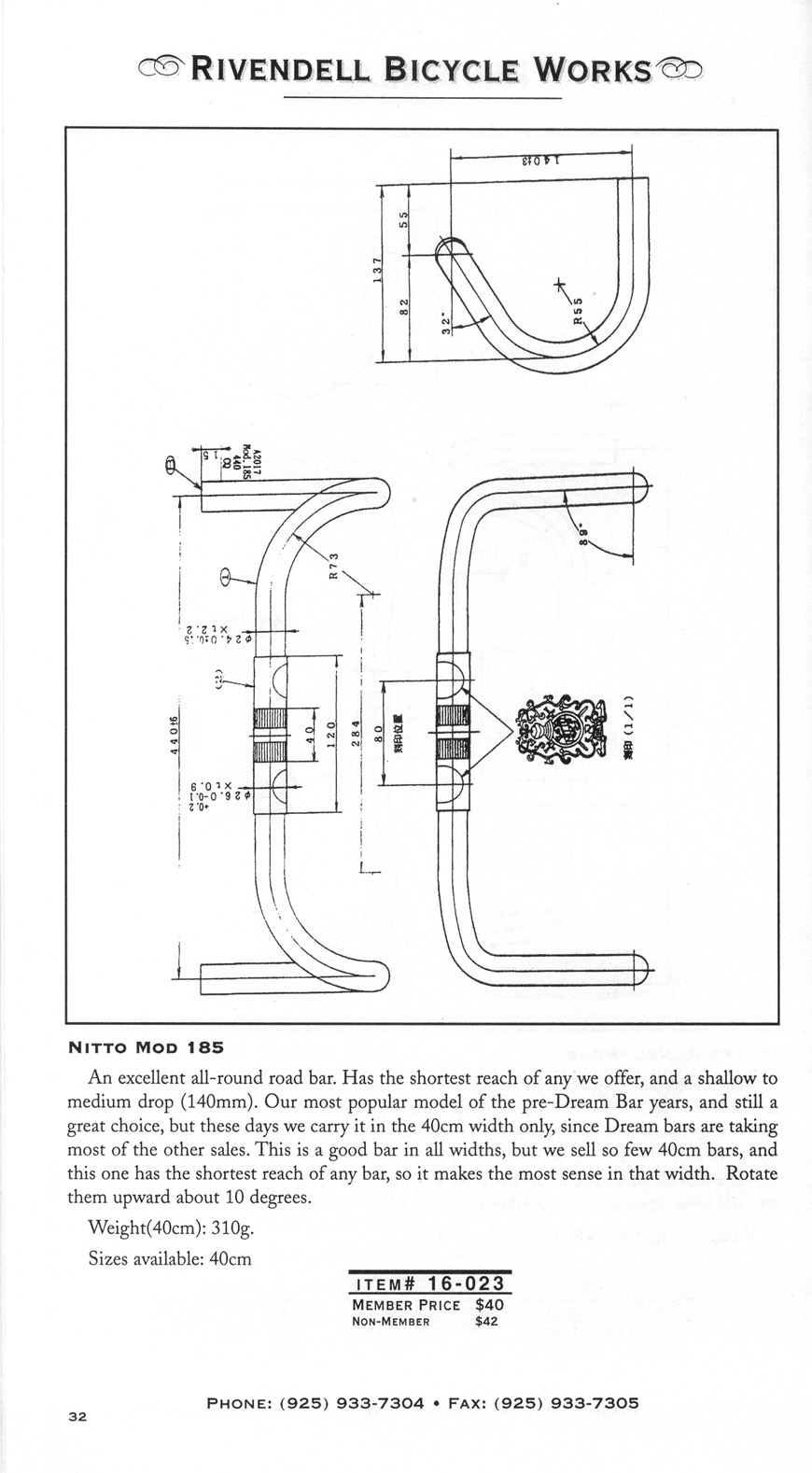
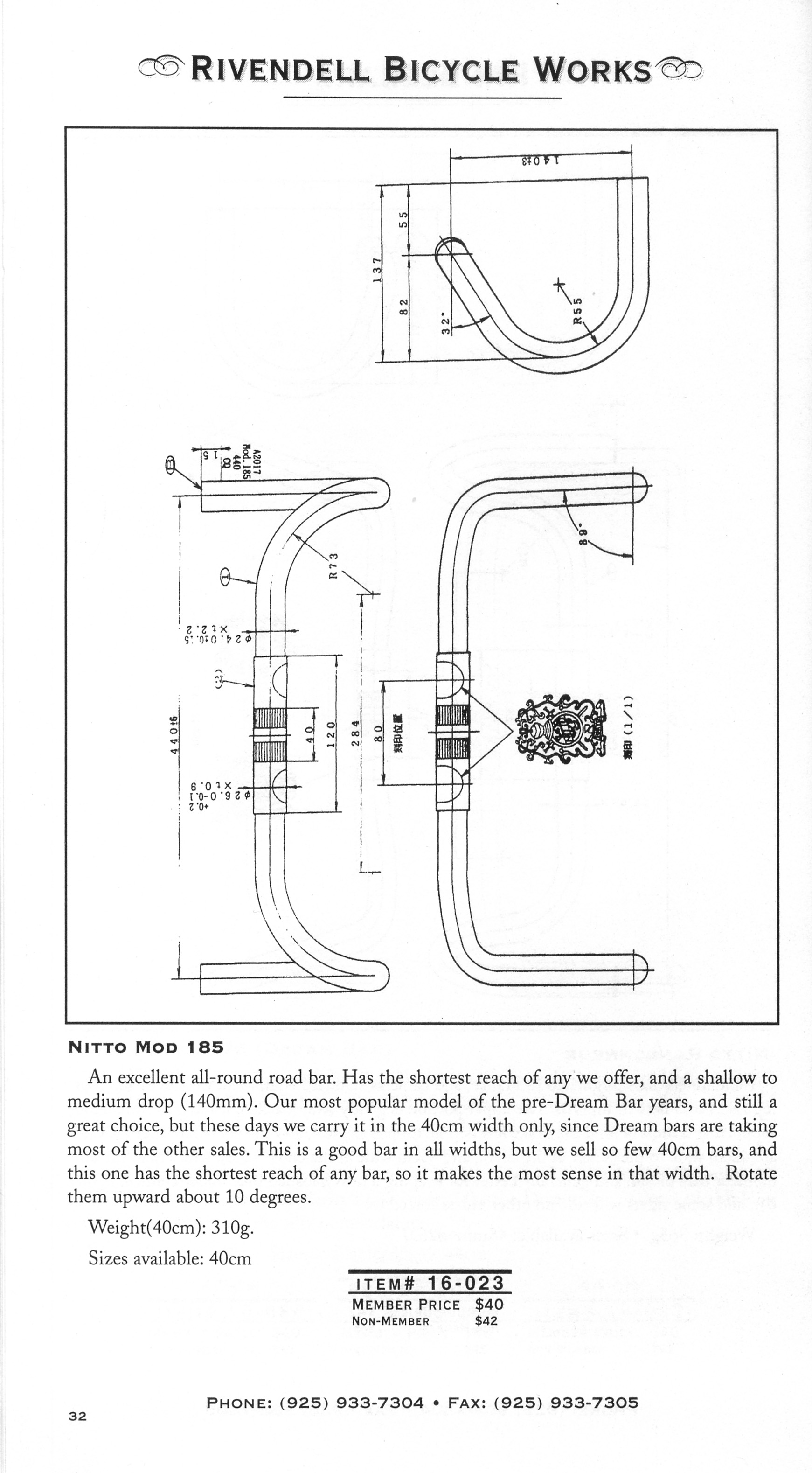
This
was a requst from a RBW List member for info about the Nitto
Model #185 Handlebar. This was the main "go-to"
bar before the Dream Bar (Nitto 176)
For
those of you playing along at home, the scan is from the Rivendell
Catalog #5, from the Winter Spring of 1999. I have three readable
versions of this page scanned. Clicking the thumbnail above
will get you the screen resolution version, while the two
links below would hold up for printing purposes.
Note:
Grant made this
post to the RBW
Owners Bunch list, following a general question about
the geometry of the new frame series. You can find it in the
list archives, but I wanted to keep these points easy to find.
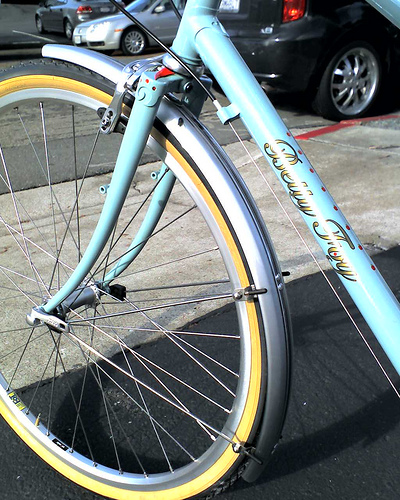
The quickie photo of Betty above is from my too-short test
ride while on an RBWHQ&L visit today - doesn't do it justice
at all, but I'll be posting a comment over on my
blog pretty soon...
Begin
post:
The top tubes "read" long, but the length is sucked up by
shallow seat tube angles and high bars. In fact, they "ride"
normal, maybe even on the short side of normal. Some things
to think about:
¥
MOST riders shove the saddle all the way back on the rails.
Half of those wish they could shove it back more. The limiters
are the seat tube angle, the seat post's setback, and the
saddle rails. It is rare to see a saddle shoved all the way
forward; common for the rider to want it back more. Half a
degree--seems like a good way to go. On my own custom, it's
71-degrees. I'd do that for our non-customs if it wouldn't
raise eyebrows, but...well, here we are!
¥
One degree over 55cm equals one centimeter. So, for a 56cm
frame, it just gives you the possibility (doesn't force it)
of an ant's whisker more than 1cm rearward. The "cost" of
this is that you can't move the saddle as far forward, but
as long you're not poking the saddle toward the bars and wishing
it would go more, the added cm in back is only a benefit.
Does that make sense? It doesn't force you back; it allows
it if you want it, with no drawback UNLESS you're a triathlete.
¥
I have some suspicions as to why shallower STAs are not more
common. One is that riders are accustomed to 72s, 73s, and
74s. Long live diversity of opinion and all that, but I have
to do my best on the bikes I design for our customers, and
I think it's great idea. Minority opinion, whatever--I'm not
saying I'm smarter or others are dumber, just that it makes
sense to me.
¥
Bikes with supershort chainstays won't go shallow, cause the
wheel will hit the seat tube. That's an argument against short
chainstays, not shallow seat tubes.
¥
Most commercially available bottom bracket shells won't easily
accommodate both a big drop and a shallow seat tube angle.
The "rear angle of the chainstay and seat tube sockets is
too steep for it. Our shells are our design, and although
they aren't freaky, they are designed with shallowish seat
tube angles in mind. (This may 'splain why other lugged builders
stick with steep, although it may be a preference, too. They
may believe the myth that short femurs should go with steep
seat tube angles. That is "flat-earth", but it is still the
common belief, simply because it's been repeated and printed
so often. In any case, tiggers can do anything they want,
easily, and they don't seem to take advantage...)
I
am pretty sure RR41 will make things clear. Think of the Da
Vinci drawing of the naked guy with long curly hair extending
his arms. Think of how that applies to arm reach and bar height.
It's key, key, key...
Anyway,
it's only half a degree--and probably should be a whole one.
All it does is expand your rearward options by removing a
centimeter of your forward options (less on a 48 or 52; a
bit more on a 60). It's not a bad deal.
Bill
M. is entirely correct----the halfa degree just gives you
that much more real estate in the area you want it.
We
have the 56 in now. By Jan 2 - 4 we'll have another 56, plus
two each of the 48s, 52s, and 60's. They're coming in painted
colors that won't be final, so we'll repaint some of them,
and that'll take a week--but by Jan 12 we should have all
sizes available for testing-- and if any of you are local,
I sure hope you come by and try them.
We'll
set them up with average stems, normal bars, and you're free
to take them for an hour, and...it'll be fun!
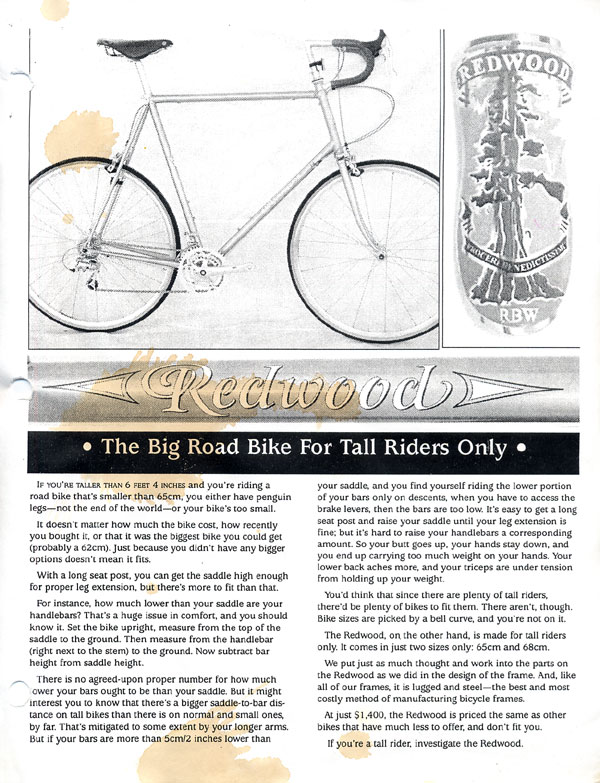
The
Rivendell Redwood "Draft" Version of the Never-Printed
Flyer - 11/08
After
scanning the color Romulus
flyer and putting out the word that I was looking for
more ephemera, I received an email from John at Rivendell,
who had in his files a draft version of the never-published
Rivendell Redwood flyer. He was kind enough to mail it to
me so I could get some scans.
The
idea was to create a central location for serial numbers,
to assist in recovering stolen bikes and to get a sense of
how many were produced. This was announced on the Bleriot
Owners Group on Yahoo. (You have to be a member to read
the postings.) Cyclofiend.com
Bleriot page
650B's
visit Black Mountain Cycles - 9/08
It's
always nice to get reports of Riv-sightings in the wild. This
one comes from Mike out at Black
Mountain Cycles in Pt. Reyes Station. From his tale, it
would appear that a pair of 650B-shod Rivendellians descended
upon him, and were reasonably impressed that he (a) knew what
they were talking about and (b) had a 650B/584 bicycle which
he'd ridden into work that day.
For
the full writeup, go to his
blog entry. Oh, and if you are out in West Marin, make
sure you drop by his shop and say "Hey-Howdy!"
Just
Some Notes - 9/08
I
have a nascent project to create a timeline of Rivendell Bicycle
Models. Thought I'd stick the model names here for now, and
then deal with the year attibution later. If there's one you
can think of that isn't here, give
a holler.
Rivendell
Road (semi-custom/build tuned to order by GP)
Rivendell Road Standard
Rivendell Mountain/Expedition
Rivendell Longlow
Rivendell All Rounder
Rivendell Cyclocross (not the Legolas)
Heron Road
Heron Touring
Rivendell Atlantis
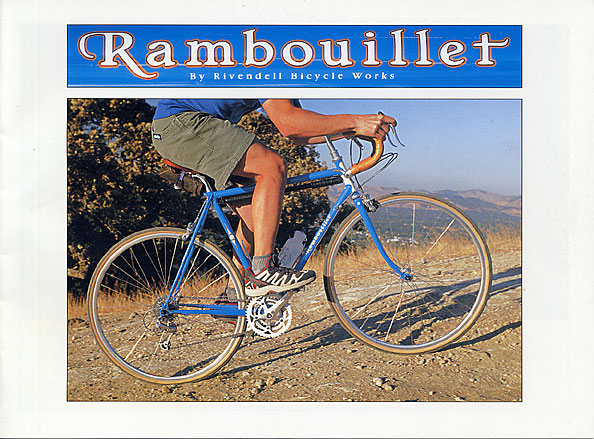
Rivendell Rambouillet
Rivendell Romulus/Redwood
Rivendell Custom (true custom)
Rivendell Quickbeam
Rivendell Saluki
Rivendell Glorius/Wilbury
Rivendell Legolas
Rivendell Bleriot
Rivendell A. Homer Hilsen
Rivendell Bombadil
Grant
Petersen: Rivendell Bicycle Works article by Gary Boulanger
Don't
quite know how I missed this one, but there was a nice Grant
Peterson interview article which appeared on Bikeradar.com,
written by Gary Boulanger. It seems to have been written in
2007.
I've
also reworked the files into separate directories, so that
you can get to the individual models by just adding "/rbw/modelname"
to cyclofiend.com. And even though the AHH uses "hilsen",
you can still use "ahomerhilsen" and get to the same place.
If
you have old links to the original model pages which ended
in ".html", those will simply redirect to the new pages, so
yo don't need to worry about changing your links or bookmarks.
which
have pulled together flyers, tidbits and scans, as well as
aggregate all the Gallery listings for those models.
Grant
Peterson Interview on Cycloculture - 8/19/08
Forbes
B-B over at Cycloculture.com
just posted an interview he did with Grant Peterson. Always
interesting to read what GP is thinking about, and if you
haven't been following Forbes' stuff, he's had a succession
interviews with interesting folks as of late - you can see
the GP Interview here.
Maxway
produces a wide variety frames for many bicycle companies
centered in the US. This video seems to be a promotional
piece aimed at potential new customers. Didn't notice anyone
brazing lugs when I watched it (and I think the music alone
may keep it off my "most-played" list...), but
these are the folks who more than likely will be building
the four new models for 2009.
More
Grist for the Rumour Mill - 4 New Taiwan Made Rivendells for
2009 - 5/08
The
announcement that the Bleriot was going away provoked a number
of responses, and Grant emailed me a couple of updates regarding
the newer models - both of these appear in the RBW
List at Google groups, and I'd encourage you to follow
through all of the discussion which followed. But, I have
found myself quoting the original posts so many times, I thought
it would make sense to put them somewhere easy to find:
Bleriot etc:
I got tired of too many dealers de-dignifying it as a loss
leader, and so I'm just pulling the plug on the whole Bleriot
program. That means that after about late June, no dealer
who doesn't have them will be able to get them. We'll then
be obligated to buy up QBP's stock, which will give us enough
'riots for a few months, maybe even through winter. They will
not go on sale; still $750.
The
QBP partnership was pleasant, I have only the best things
to say about QBP, but it was about a dozen and a half dealers
that sealed the Bleriot's fate.
We
could, I suppose, continue to get them ourselves. But the
original deal was created with the help of QBP's trading company,
and it wouldn't be fair for us to tie up its time with business
that no longer involves QBP. So rather than put them in the
position of "handing off" the Bleriot deal to a competitor
trading company--after they'd worked so hard on the details--I'm
just going to kill the fine bike and start fresh with another
trading company and a few more bikes, which--if all goes well
which it hardly ever does--will be ready in about January,
March, May, and July of 2009.
The
concepts are: Cheap Quickbeam, cheap A. Homer/Saluki, cheap
Atlantis, and cheap Mixte. The plan is four sizes each: 48-52-56-60,
all with 6-deg upsloping top tubes (like Bombadil), so each
size will fit a wider rage of leglengths/riders.
I
say "cheap," but the quality will be the same as the Bleriot.
Made in Taiwan. Our lugs, crowns, bb shells, tube pick, 'ame
& 'phics, all that. Probably they'll be one-color (no cream
head tube), and m-m-may retail for $700 or a hair less (not
$699.99!).
Our minimums per bike are 150. So, four sizes is about 37
each, which will give us good depth and stock for a while.
Meanwhile,
we are getting in a last run of real Quickbeams---70 of them
late this summer, in Silver with blue graphics.
Toyo's
production is low and slow on the normal bikes, so we're supplementing
it with Wford A. Homers and then some Atlantis frames. Toyo
sort of expects to catch up in about 9 months, but I'm not
optimistic, and that's why we're relying on Wford to fix the
slack.
Customs:
Curt's on his own now, and we're training a new builder (new
to us). I know this guy, have for 25 years, he's done repairs
for us for 3 years, he does NOT have his own brand and says
he wants nothing to do with it, and I actually believe him.
First he'll build 30 protovelos for us--or however many it
takes for him to get his groove and get really comfortable
with the particulars of our bikes.
I'm
tired of frustrations, but overall things are really good.
We have a new (second) full-time shipper; Miesha's back and
here with her baby (Freddy) and doing well. The site is getting
better. We'll soon have instructional youtube videos for various
things we get asked about all the time (twine, shellac, mounting
racks, and then just fundamentals like fixing flats).
New
RIV bike geos and fits:
The 48 will fit like a horizontal top tube (htt) of a 51 or
to to 56 or so. The 52, like a 53 to 60; the 56, like a 57
to 63 or so, and the 60, like a 62 to about-how-we-say-a 66.
The explanation is simple, and it is: The top tube slopes
UP from the seat lug, NOT down from the head tube. So front-end
height is easily had. If you're on the small end of a new
bike size, you'll probably sink the stem in deep---an odd
thing for most Rivvies (I think that's a Beth Hamon term,
not sure), but with the SU (sloping UP) top tubes (TT), it
makes sense. Saddle height is never a problem, not with today's
500mm seat posts.
So...the
new sizes will fit a gigantic range of riders, all with four
sizes.
I
know the SUTT's don't have that Stradivarius look, but the
goal of these new bikes is to make solid, fantastic, versatile,
comfortable, lugged steel bicycles affordable to more people;
to make it easier to buy (for instance) an Atlantis-style
bike (touring) even if you can't justify a $3,000 real one
because you aren't a full-time wealthy vagabond. Our bikes
have a certain look, and these will too. But the function
and the sense of the SUTT seems appropriate for the new bikes,
and I think it's good to apply a different Aesthetic Yardstick
to a $700 frame than to one that costs twice or more of that.
The
Bleriot has "that Rivendell look," true, but we could never
afford to buy enough of them by ourselves (without QBP's help)
to be able to stock sizes deep enough to ensure good supply,
and that matters.
The
SUTT is only 6-degrees, or about four more degrees than our
current bikes. It is the same as the BOMBADIL, which you can
see on our site. So: I'm a fan of these bikes even before
they're here. Of course, on one hand I have to be. But on
the other hand, we're the force behind them---they aren't
being forced on us, and now we gotta defend them. Not at all.
I'm really excited about them.
These
days, to me, a nicely detailed bike that forces on you a low
bar and skinny tires. I look at bar height-ability and tire-ability...and
lugs, somewhere along the line.
TRAIL:
I'm GETTING tired of this topic, and have only this to say,
for now: You can get used to anything and learn to love it.
The power of suggestion is strong, especially in Matters of
Subtle Differences and Subjectivity. All that said, Trail
is a stabilizing force, which means to some extent is can
make a bike safer to ride, less easily jostled-to-crash than
a bike with too little of it.
I'm
not one to quake at the thought of going against the conventional
wisdom when I think it's off, but in this case I don't think
it's off. If it were off, then the tens of millions of happy
bikes and riders in the last half century and before wouldn't
have been so happy and content. I understand that THAT logic
can't be applied as successfully to all matters in and out
of bike design, but I think it can apply to trail. There may
be certain circumstances that benefit from a little more or
a little less (with the extremes of riding out there, it would
have to be that way), but for day-in/day-out riding, trail
figures in the high fifties to low sixties work great.
Here's
an odd fact that is troubling me some: The current 52 Bombadil,
the one so many people have ridden (including Chico Gino,
who reported on it in his blog), rides great by All Accounts.
I have never ridden a bike that rode an iota better, more
pleasantly, easy flowing, easy to control, slippery and grippy
in all the right places. I have ridden it on several S240s
with weights ranging from 27 to 55 pounds, and no problem,
it feels like a bike. Unloaded, it feels like a road bike
(too much like one, for my taste). The troubling part is:
68mm of trail. It is troubling because "trailists" will see
that figure (or figure it out from other numbers) and doubt
the bike they'll never even ride. Trail theory says it should
suc* going uphills slow, yet it doesn't. So right now and
over the next week or so I have to decide between sticking
with something that I know works, or "designing to theory."
If I do that, I'll dig into my bank of experience or whatever
it is and make a conservative shot, but if I do that, I'll
feel like I'm caving in. A slight loss of self-respect, but
fewer future headaches?
FLEX:
A certain amount is fine, too much is not, and it's not a
significant source of "energy/speed loss." If you believe
that a bike can't be too rigid, then you'll naturally like
rigid bikes better, and equate them with goodness and speed.
If you believe a little flex feels good and doesn't slow you
down, might even help the way a flexy dance floor or gym floor
helps the jumps, then you'll enjoy the slight, nearly but
not quite imperceptable flex in a moderate frame. Too much
flex is a problem when it causes "ghost shifting," which is
real shifting caused by the fame flexing enough to move the
rear hub away from the upper pulley, resulting in the chain
being de-railed to the next hardest cog. If you're too much
guy for a particular frame, you may find this happening on
steep climbs; but check your shift lever tightness first,
and make sure there's no excess friction in the system. Other
opinions abound, and seek 'em out!
Rolling
resistance varies tremendously with the surface and tire pressure.
The prevailing opinion, which I go along with, says that rougher
roads need softer tires that roll over and absorb the bumps,
rather than hitting them and bouncing skyward. One example
of "conventional tire wisdom" that I doubt-to-don't-believe,
is the idea that a supple sidewall makes a whopping difference.
Sidewall suppleness is most obvious when there's no air in
the tire, and even MORE MOST obvious when the tire isn't even
on a rim. Once you mount and inflate two tires, one with a
supple sidewall (SS) and one with a firmer sidewall (FS),
then the differences are insignificant. If both tires inflate
to 75psi feel different, then they will behave differently,
too. To make the FS feel like the SS, you may have to reduce
its psi by 5, and there are no drawbacks to doing that.
But
here again, it's kind of a case of magnifying amoebas, since
(1) compared to wind resistsance, rolling resistance is insignificant,
and matters only in races won or lost by wheel-widths; and
(2) for anybody who doesn't race at that supremely high level,
it is a mistake (I'd say) to even give it a second thought.
You want a comfortable, reliable bike; a certain amount of
fitness; a friend to ride with, and a safe place to ride.
If the weather's good and the scenery is decent, that's all
you need. That's not to say you shouldn't enjoy discussions
about bicycle theoretics, but in the end, don't forget to
re-size their importance...is all.
BUILDER:
New builder is not anybodyanybody knows, I am sure. Builders
come with various degrees of fame and reputation, but no builder
imbues a frame with magical love that flows from his fingertips.
It's a romantic notion, and I'd be the first to acknowledge
that the range of skills, especially in custom builders, varies
far more than the prices they charge. In a custom Riv builder,
I am looking for a guy who loves bicycles and is at home with
metal and tools, and has personal metal- making standards
that are higher than my own, and won't take short cuts. I
also look for, and have found somebody with decades (more
than three) of experience building some of his own frames
(including a custom for me way back) and repairing hundreds
of the finest frames in the world. I know it is impossible
to stop the speculation, so speculate away, but in the end,
it will be a RIvendell frame, not a _______ _________ frame,
because it is our design, our lugs, our concept, our choice
of everything. Frames from him are still months&months away,
and when they finally start to flow, they will flow glacial-like!
Hot
off the mojo
wire - rumours of the cessation of Bleriot
production have been confirmed:
From
John @ Rivbike -
"Some
news from here. Nothing etched in stone. Details forthcoming.
The Bleriot, made in conjuction with QBP, is going away at
the end of June.
It's
been a great frame, at a great price. QBP was great to work
with, and there are no bad feelings on either side.
If everything goes according to plan, we will have new frames,
also made in Taiwan, also attractively priced, available next
Spring to our own retail customers and to our dealers. It
will be a Riv-only thing. We will still sell Japanese and
American frames. This will just be an additional tier. The
quality will be commensurate with the price. Better, in fact.
They will be good, strong, attractive bikes.
Expect
a Mixte, a Hilsen-like, and an Atlantis-type. That's all we
know for now. Pricing, geometry, colors, details, and sizes
to be determined. Have a good weekend, everyone."
Sad
to see such a fine model come to an end, but... holy-moley!
Three new models at a lower price point! Can't wait for more
info there...
Rivendell
Garage Sale and Semi-Unofficial Ride Announced
There's
been a
post on the RBW site announcing a Garage Sale which will
"take place at 8:30 and not a minute earlier" on
Saturday, July 19th at the RBWHQ&L. This is good for me,
as I am committed for the entire day elsewhere, and really
shouldn't be spending extra money for the goodies I'd expect
to find there.
I'm
more bummed about missing the 10:30 am ride which was also
announced. as I don't get over that way too frequently, and
the topography is pretty wonderful - Mt Diablo roads and trails
are well worth it. I certainly enjoyed myself at last year's
Rivendell Weekend.
So,
you should go and share photos and stories - mark your calendar
Saturday, July 19th!
Friday
Night at the Movies - 5/23/08
Rivendell's
first posted video. In which Mark at RBW carefully layers
on the base coat of shellac on a near-finished Glorius. Enjoy!
Jack
Brown's on CyclingNews.com
The
fine folks over at CyclingNews.com
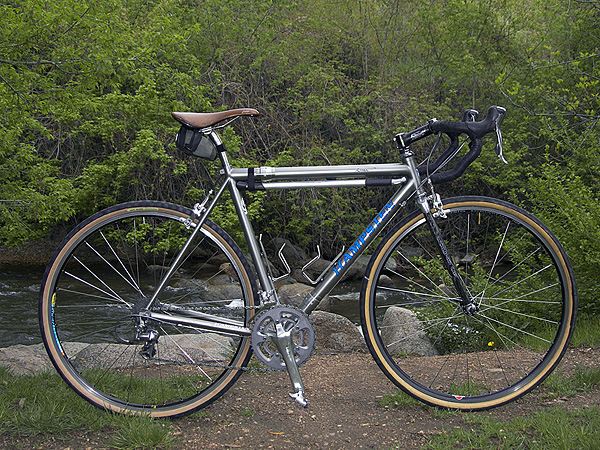
have an
excellent tech article on the Hampsten
Cycles Strada Bianca Ti Travelissimo, which is the personal
ride of Andy Hampsten (profiled in a recent Rivendell Reader
as well - if you aren't familiar with Andy's exploits, see
if you can find a Bob Roll essay called "The Day the
Big Men Cried", or Andy has a description under a similar
title, "The Day the Strong Men Cried". Epic stuff.
)
"The
cleanly welded titanium frame and carbon Wound Up fork are
designed around the larger 28-33mm tires that he prefers
for their ability to handle smooth pavement or cobbles with
near-equal aplomb as well as their awesome cornering traits."
Over
on the front page of the Hamsten
Cycles site, there's a stunningly appointed, fully fendered
classic-looking bike which is clearly wearing a plaid Nigel
Smythe Country Bag. That'd be a Tournesol
Randonneuse, if you are keeping score.
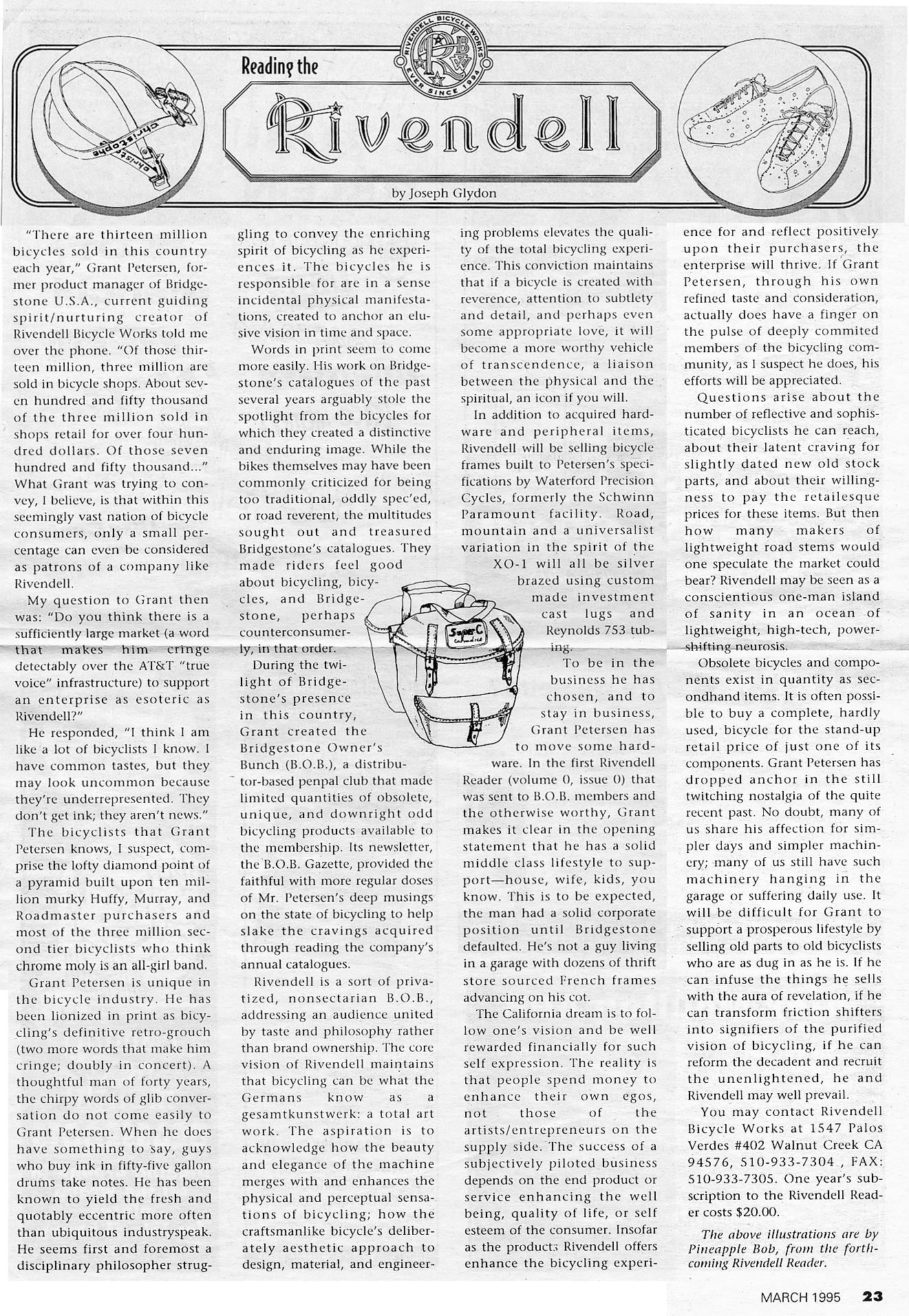
Since
I'm battered by bronchitis and enjoying the start of antibiotics,
scanning stuff seems to be the greatest challenge I can
meet today. This is an article I had saved from the March,
1995 edition of California Bicyclist magazine. It was about
a year into the Rivendell adventure. I particularly enjoyed
rereading the second to last paragraph, which said, in part
about Grant,
"If
he can infuse the things he sells with the aura of revelation,
if he can transform friction shifters into signifiers of
the purified vision of bicycling, if he can reform the decadent
and and recruit the unenlightened, he and Rivendell may
prevail."
In
a secret testing facility somewhere in NorthernCalifornia America. Not by me. Doggonit!
UPDATE
5/08 - Gino's BombaBlog Report can be enjoyed here
Another
Bombadil Prototype - from the ToyoBlog - 2/18/08
Looks
like the fine folks over at Toyo
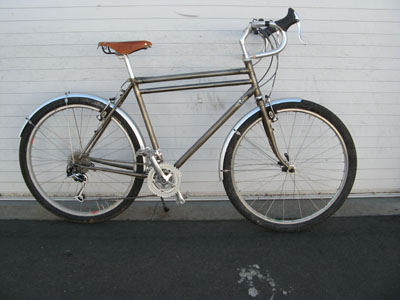
have delivered another prototype of the Bombadil 650B/584
mountainbike. This one features a twin top tube, reminescent
of the early days of Klunkerz on the mountain. GP has mentioned
that he wants to make this bike "bombproof" and
has been rethinking additional bracing, such as a
curved forward tube. (Toyoblog
translation supplied by Google).
There
is also a newly updated Bombadil page which aggregates information
on this bicycle
2/3/08
- Thanks For Everything, Sheldon
Sheldon
Brown
1944 - 2008
Rivendell
just posted the
interview they did with him in RR25 a few years
ago. All across the net, memorials
are blooming and recollections shared. We owe him a
debt of gratitude and should feel lucky to have enjoyed
his precense.
Russ
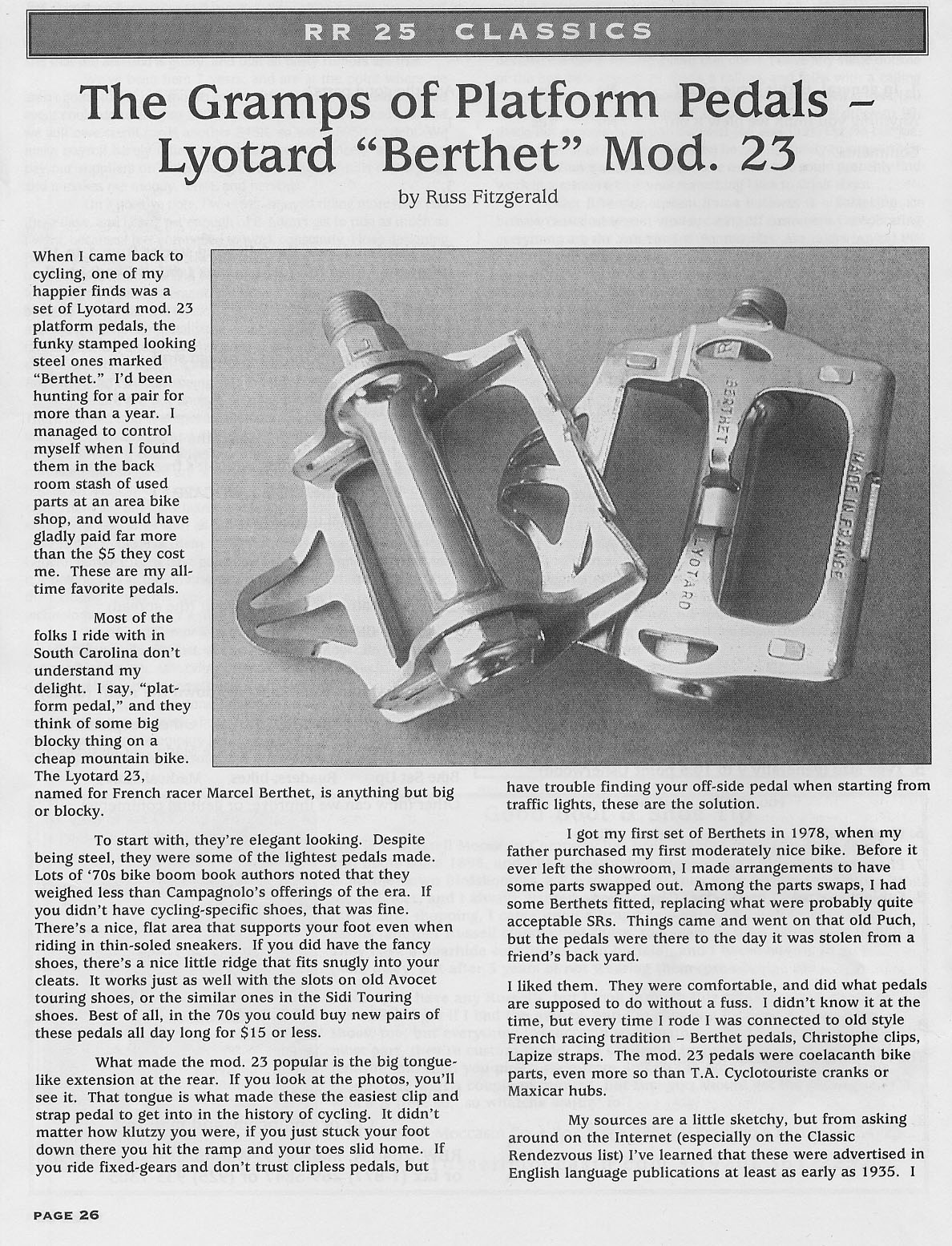
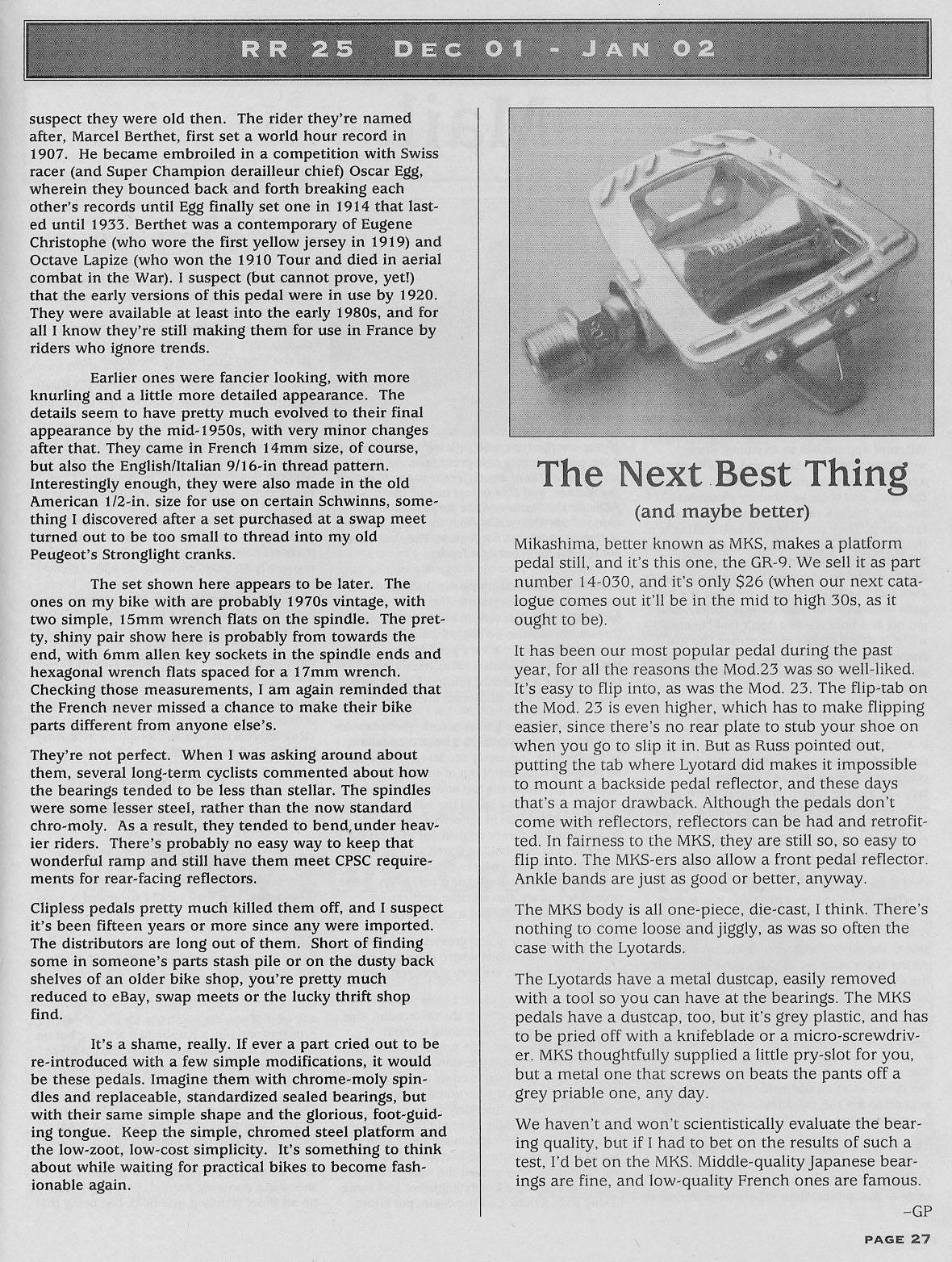
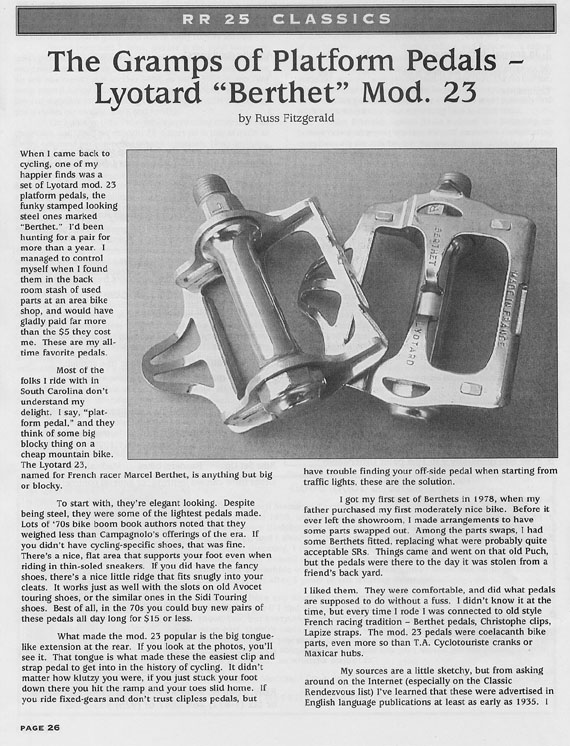
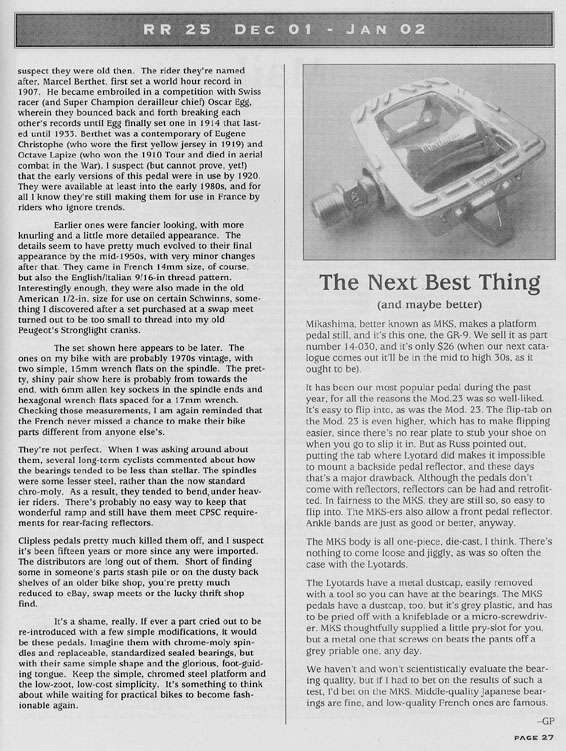
Fitzgerald wrote about the Lyotard "Berthet" Model
23 pedal back in 2002 (Rivendell Reader #25). This article
got some attention recently in an iBob
thread, so I'm reprinting it here for reference. Scans are
hi-rez - click on the page image below.
If
the hi-rez images are too big, I've got some scanned at 72
dpi - page 26
- page 27
Sorry
for the mish-mash here - I realized I'd been squirrelling away pdf's
which I'd linked in list-posts, but hadn't ever created a hard link
within this site.
Company
Info: Rivendell
Bicycle Works
P.O. Box 5289 Walnut Creek, CA 94596
T 800.345.3918/ 925.933.7304
F 877.269.5847
If
you are looking for information about Bridgestone bicycles, I have
a reproduced page on serial number conventions here.
The best source for further information would be Sheldon
Brown's Bridgestone Bicycle Pages.
Please
note - this is absolutely not meant to be a comprehensive representaton
of Rivendell Bicycle Works, their products or their policies.
Please visit their
website, or contact
them directly regarding these products.